UPDATE [Video]:120|HT sets 80-foot pedestrian bridge in Vermont
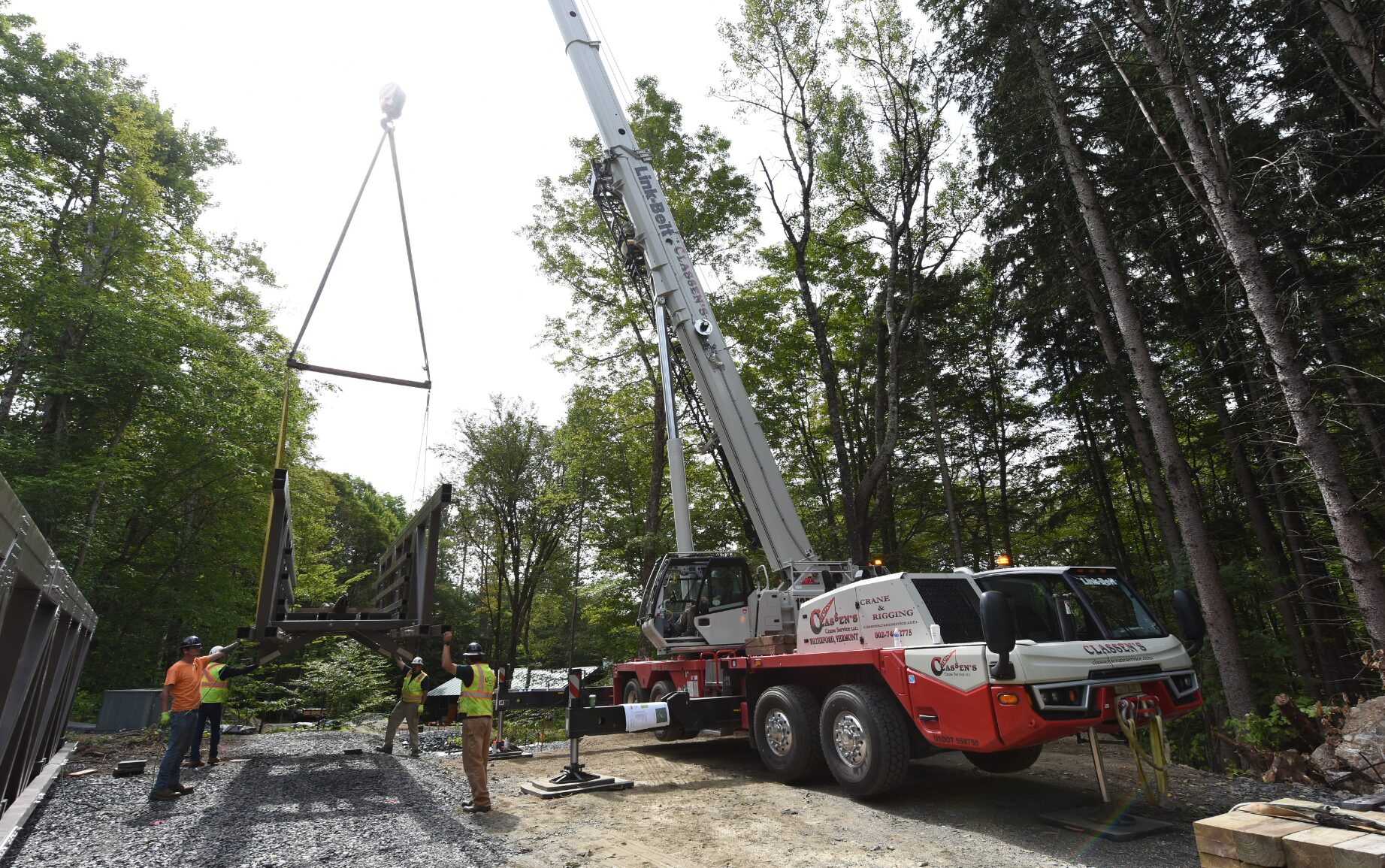
A Link-Belt Cranes 120-ton 120|HT lifted and placed an 80-foot-long structure as part of a bridge replacement job led by Classen’s Crane Service of Waterford, Vermont. Assembled in two parts, the structure weighed a combined 15,500 pounds and was placed at a 65-foot radius with 125 feet of boom extended.
The crane fulfills a niche role in Classen’s fleet, replacing their 100-ton Link-Belt HTC-86100 and sitting comfortably in between its 175-ton 175|AT and its 65-ton Link-Belt truck crane. Vice President Ben Classen said the 120|HT met each of the company’s requirements when looking for a new machine.
“When we look for a piece of equipment, we look for capacity, reach and availability of service in the remote areas we work in,” Classen said, explaining that the company primarily works in hard-to-access locations such as mountaintops. “The five biggest things that drive our focus are service, service, service, service, and service. We get that service from our dealer CR Woods and Link-Belt.”
The crane’s impressive combination of capacity and reach was demonstrated clearly on the bridge replacement job, where its 164.1 feet of telescopic boom truly made the difference.
“The extra boom length, it makes a big difference,” Classen said. “It lessens the need to use the jib that requires more set-up time and space, and it is American made.”
The 80-foot-long fiberglass pedestrian bridge was transported in sections from Texas, replacing a deteriorating wooden walkway built in 1972 in Fayston, Vermont. Once assembled, the structure was lifted and placed above a 30-foot-deep ravine.
Classen crane operator Jacob Davis said the 120|HT, which has already logged 600 hours for the company, was perfect for the job.
“I think this crane was the right choice for this job because of the capacities and radius we’re working here as well as the weight of the bridge itself,” Davis said. “We needed that specific boom length and the right capacity combined to be able to set it at about a 70-foot radius, especially when we were not sure of its weight with rigging.”
He said he especially likes the crane for its simple setup and assembly as well as its exceptional boom length, which provides a distinct advantage when working jobs that require significant reach, including lifting HVAC units onto building tops and cell antenna projects. Along with this, he said the machine’s Pulse 2.0 system is easy to operate and very helpful when it comes to fine metering and establishing counterweight configurations.
“I would recommend this machine because it’s so versatile. It’s big enough to do some of the bigger crane work we have or the smaller crane work,” Davis said. “It’s a good size for a little bit of everything.”
 Facebook
 X (Twitter)
 YouTube
 Instagram